Once Upon a Time vs. In the Beginning

Once upon a time…

A recent article by Maria Konnikoiva examines the enduring power of these four little words. As she notes, some variation of the phrase appears in most languages, pointing to its near universal use and appeal. But why is the phrase so powerful? What makes stories, especially fairy tales, so affective? Konnikova argues that the phrase offers us both distance and vagueness by placing us in another time in an upspecified place. Such psychological distance allows us “the possibility of comprehending far more about reality than can come from reality itself.” And such vagueness allows us to insert ourselves into the story, to try out different lives and scenarios. Such stories, then, offer a kind of virtual reality in which we can process our own stories. As Konnikovia says,

“The world of once upon a time is not reality. It is a creation of make-believe. It is an invitation for fantasy and imagination to take the stuff of real life and do with it what they will—and perhaps, to translate the newfound truths back from story to actuality. In the realm of the imaginary, anxiety doesn’t become less anxious, nor tragedy less tragic. But in that world, you can make sense of it all from a distance. It can’t touch you in quite the same way—and yet it can lead you to a much deeper understanding and feeling of realities that would be too impenetrable without those four magic words at the fore.”

Konnikovia argues that stories, especially fairy tales, have psychological value because they give us a place to ennact pieces of our own lives and a means to process our own anxities. And while I don’t want to deny this pscyhological function of stories, because I have experienced it myself, I do want to contrast it with what I take to be a Christian understanding of story.

Take the way the Bible begins. “In the beginning…” pulls us into the narrative in similar way to “Once upon a time.” But while “In the beginning” gives us a sense of distance, it is only a chronological distance, more akin to “Once upon our time.” No matter how far back those words stretch, we are placed firmly within our own time and space. Whatever one thinks about the historiticity of Genesis in general or of chapters 1-3 in particular, the Bible wants us to know that this is our story and this is where we came from.  

As another example of Biblical storytelling, consider the opening of Samuel. It begins, “There was a certain man…” Such a phrase offers us neither distance nor vagueness.  Here we have a specific man in a specific time with specific wives and and specific problems. We are not distanced from this man, Elkanah. Rather we are thrown into the middle of his family sorrow–his beloved wife Hannah is barren. Yet in the midst of all the specificity, fairy tale like things happen. Against every odd, Hannah conceives a child. Even in our age of fertility doctors and artificial insemmination, the reversal of barreness is a kind of miracle. And the song Hannah sings in exulatation to the Lord has all the sweep and force of epic poetry, cataloging a host of reversals: the rich become poor, and the poor become rich, the proud are cast down and the humble are exalted, the fertile become barren and the barren become fertile. Indeed, one of the great tropes of stories is reversal–the unexpected the rise of the unlikely figure, and it is one of God’s favorite tropes. We need only look to the incarnation and crucifixion to see that God loves reversal and that he knows how to tell a story.  

To put the contrast another way, while Konnikovia’s approach rightly affirms the benefit stories have for our understanding of reality, the Scriptures point to something even bigger–the narrative shape of reality. It is one thing for us to examine our lives by means of other stories. It is quite another to affirm that reality itself is a kind of story and to thereby conclude, whether consciously or not, that there is a storyteller. From my bias, one reason fairy tales are powerful is that for all their fancy, for all their distance and vagueness, they point to the narrative shape of reality. Indeed, even when stories aren’t “true” they inevitably speak to the narrative shape of our lives by pointing to true things. This is because we live in the world of “in the beginning” where God spoke or “narrated” everything into existence.  In the God narrated world, we cannot help but place ourselves in stories because we cannot help but see our lives as part of his story. 

I suppose a merely psychological understanding of narrative would say that natural selection is telling the story. If so, then one reason I believe in God is for completely aesthetic reasons–I think a creator God who narrates the world and who is bringing reality to its ultimate conclusion makes for a better story than Darwin and the Big Bang.


Earnest Words in Swirling Noise – Yankee Hotel Foxtrot at Ten

Early in college, I fell in love with Wilco. I know how that sentence sounds, but I’l write it anyway, simply because I also know how many others could write the same thing. Or if not about Wilco, then about some other band that has become synonymous with the glories and terrors of coming of age in a city not your own. So last week’s tenth anniversary of their greatest album, Yankee Hotel Foxtrot, was something of a moment for me. Not because I can’t believe it’s been ten years, but mostly because I still haven’t outgrown YHF. So much of what I listened to and read and thought and believed ten years ago has proved both embarrassing and ephemeral. But not YHF. It’s importance has only grown for me. For one, the album has such a stranglehold on my sense of taste, that I can’t help but judge other music’s greatness by its standard. It is truly canonical for me, by which I mean it is a measuring stick for other artists and albums. For another, it in some sense shaped my own sense of wanting to write. More on that later.


Image

Before YHF came out I had devoured *Being There* whose tracks “Misunderstood” and “Sunken Treasure” stand among my favorite all time songs. And Summerteeth was a revelation–Beatles and Beach Boys filtered through alt-country swagger. Still, for all their greatness and the obvious experimentation in those albums, nothing could have prepared me for YHF.

I bought the album the day it came out, back when people did such things. On the way home, I sat alone in my car and listened to the opening track over and over. The seven minute dream wrapped in a nightmare wrapped in a dream that is “I am trying to break your heart” took immediate hold of me. I don’t even remember driving back to my dorm. I only remember listening to that song on repeat and the vague impression of lights flashing and passing me in the dark. It was the strange lyrics, the almost haphazard drums, the plink of the child’s piano, the strained and weary voice. But mostly it was the swirl of noise, the impending sense of chaos. I reveled in the noise, turned up the volume, let it wash over me.

As the best articles celebrating the tenth anniversary of the album have pointed out, the whole album is about wanting to be understood and also about the terror of actually being understood. It’s about vital messages coded in noise and misdirection, and about the hope and fear there is someone on the other side to both receive and decode those messages. Those messages come mostly in the form of ambiguous lyrics. I will never really know what “I am an American aquarium drinker” means exactly. I can’t exegete the deeper meanings of “take off your bandaids cause I don’t believe in touchdowns,” or delve the implications of “our love is all of God’s money.” But I love these lines. Such lyrics are at once ambiguous and earnest. They are exactly the things I was trying to say, but couldn’t or wouldn’t. I understand that these are the very reasons some people hate this album. And in the hands of lesser artists such lyrics are nothing more than nonsense, or worse still unbridled pretension. But for Wilco, layered in the haze of static and delivered in Jeff Tweedy’s broken voice, such lyrics are messages about the inherent fragility of messages. There is so much say and so many ways for that to be misunderstood.

In college I started writing poetry. Partly because I had always wanted to write poetry and partly because I was hopelessly enamored with the girl who edited the literary journal for the English department. The fact that she would read the entries spurred an incredible flurry of terrible poems. And the fact that she would read the entries meant I would never dream of submitting them. Even though they weren’t anything resembling a love poem, and even though they weren’t veiled confessions of devotion, I still felt I would be exposing a nerve. I couldn’t risk being understood.

Eventually, I let other people read versions of those terrible poems. And I even wrote some more. I guess I figured that even if people got it wrong, or worse still got it right, and I was found wanting, it was still worth writing. This may have been because I came to see that the world often feels like YHF sounds.

At the end of “Poor Places,” there is a swell of static, and as it peaks you hear the faint accented voice of woman emerge from the noise. She repeats the phrase, “Yankee. Hotel. Foxtrot,” over and over, even as the static get louder and louder. It is clearly a code, a message veiled in subterfuge. It is not meant to be understood by just anybody. But it is meant to be understood by somebody. I heard those three words, sent out across radio waves, hoping to alight somewhere and to be heard by someone, as an apology for art, as a kind of artifice themselves, a cry made in hopes of making sense of things in the midst of chaos. 

In this same vein, I’ve always find a particular lyric in the closing song arresting. In “Reservations” Tweedy sings, “The truth proves it’s beautiful to lie.” Like the rest of the album the statement is veiled in ambiguity, but one way to take it is that the truth makes art necessary. We have to interpret our world, and that world is often enveloped in noise and static, not unlike much of YHF. Even so, we can take the noise and make it into something. When it comes to art, the artifice is a kind of lying, but to me such artifice proves that the world is worth paying attention to and worth interpreting after all. This is certainly why I type out words that maybe only a handful of people will ever read.  I am simply trying to make sense of the noise. I am hoping, praying even, that as I tap out dispatches, there is someone on the other end.

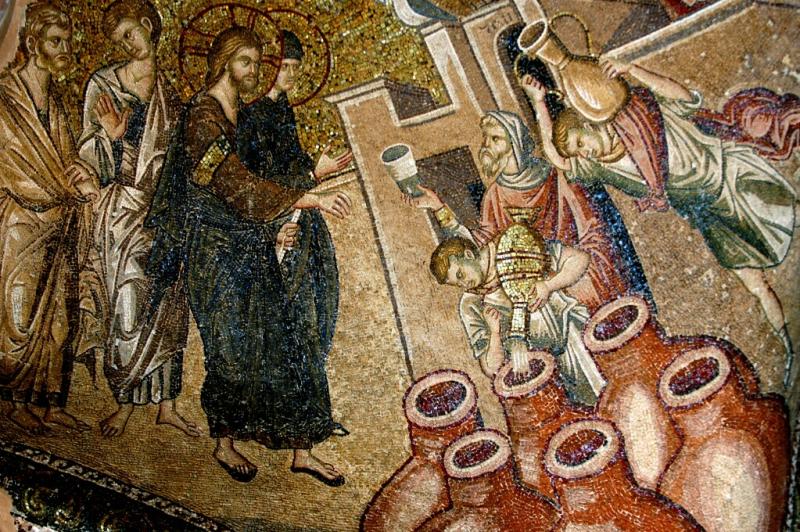
Water into Wine – The True Nature of Epiphanies

“I disapprove of epiphanies and their phony auras but I am besotted by them — can’t get enough of them in life or elsewhere. So sue me. Seriously though, as a person who was brought up with religious faith and then got out of it, I’m always looking for secular manifestations of the sacred.”  Charles Baxter

I wrote a paper on John 2 this past semester, and in his feedback my professor noted that the water into wine story is part of the lectionary reading for the feast of Epiphany. He thought this was an interesting connection between the story itself and the idea of epiphanies in literature.

Indeed it is an interesting connection. And I got to thinking about it and reading up on it, and it turns out the epiphany has fallen on hard times. The epiphany in it’s truest form comes from Greek Mythology. Gods and goddesses break into the human realm, and people are overcome with the presence of the divine. In the Bible the epiphany is more properly called a theophany or christophany. Think of the burning bush. Think of Jacob wrestling the angel. Think of the Mount of Transfiguration. Think of the Ascension. The Bible is so thick with epiphany that it is almost commonplace. Indeed, the Bible is an ever increasing cascade of epiphany culminating finally in the eternal epiphany of God dwelling with his people (Rev. 21:3). What is interesting is that n both the Greek and Christian understandings, the epiphany’s center of gravity is the divine. The human’s experience is one of revelation. It is not experience, in other words, that comes from within, but from without.

But epiphanies are very different in literature, and we have James Joyce to thank for that. He was the fist to self-consciously use epiphany as a literary term. For him the epiphany was, a “sudden and momentary showing forth or disclosure of one’s authentic inner self.” It was a way to describe a particular moment of clarity, usually towards the end of a story, that characters have about themselves and their lives. (To see a beautiful example of this read Joyce’s story “The Dead.”) Typically, if and when we say we’ve had an epiphany, we mean it in this way. With Joyce the moment of divine encounter became a moment of personal clarity. The center of gravity shifted from the divine to the self.

So why would a writer like Charles Baxter hate epiphanies and write an essay called “Against Epiphanies?”  I suspect that Baxter senses on some level that the epiphany as Joyce describes it is a sham. If there is the possibility of revelation or the divine, the epiphany seems inevitable. If there is a voice on the other side, we would, it seems, in moments of clarity, distress, comfort, euphoria, in those moments, that is to say, where we come to the edges of human experience, hear that voice or encounter the divine. But in a voiceless world, the epiphany first becomes a “secular manifestation of the sacred,” and eventually, disintegrates because in our world the self is so incoherent that any moment of inner clarity would only reveal a sliver of a fragmented whole. For us truly postmoderns there is no authentic inner self to be revealed.

Without a true sense of the divine and without a coherent self, the literary epiphany becomes, as Baxter says, “phony.” Life, he insists, isn’t like that, since if epiphanies happen at all, they happen rarely. And yet he still longs for them. His self-contradictory impulses reveal an appetite for transcendence, for the divine, for there to be a voice on the other side. But contemporary literature has no space for the divine, no category for the possibility of revelation.

Despite these tensions, you don’t have to look far in contemporary literature to find epiphanies. Take Jonathan Franzen’s novel Freedom.  This scene towards the end of the novel records the reunion of Patty and Walter Berglund, who had been estranged by adultery and betrayal:

Her eyes weren’t blinking. There was still something almost dead in them, something very far away. She seemed to be seeing all the way through to the back of him and beyond, out into the cold space of the future in which they would both soon be dead, out into the nothingness that Lalitha and his mother and his father had already passed into, and yet she was looking straight into his eyes, and he could feel her getting warmer by the minute. And so he stopped looking at her eyes and started looking into them, returning their look before it was too late, before this connection between life and what came after life was lost, and let her see all the vileness inside him, all the hatreds of two thousand solitary nights, while the two of them were still in touch with the void in the sum of everything they’d ever said or done, every pain they’d inflicted, every joy they’d shared, would weigh less than the smallest feather on the wind.

Here is epiphany in the Joycean sense—a moment of clarity and closure. And perhaps even of forgiveness and reconciliation. But what does it amount to? Two estranged characters reconnect and in their connection see past themselves into what lies beyond them and what lies beyond them is nothing. This is an epiphany, yes, because the characters come to see some truth about the world but it is an epiphany without transcendence.  There is no voice, only void. And if in the end both joy and sorrow weigh less than the smallest feather on the wind, then what use is either?

So where does this all leave us? When I think of epiphanies in any sense it becomes clear to me that I ought to be wary of my own capacity for insight. I ought to be suspicious of my own sense of clarity. I am waiting for the world to act on me, to arrange itself in scrutable ways. Art is a path to such clarity, but as a Christian I sense that this is only true because there is a voice on the other side. To be an artist is to have an appetite for transcendence, and yet, in what seems to me to be the height of irony, many artists reveal that appetite in their longings for epiphany but refuse it’s true nature by denying what an epiphany really means—that the divine seeps into the world, that there are moments when we see behind the curtain and what we see is not the void, but something almost more horrifying (if we are really honest). We see the terror of God’s beauty, a beauty that exposes ugliness and strips pretense. And though we might walk away with our faces shining like Moses, we are first disintegrated like Isaiah.

Unless.

Unless that God comes to us in our form, and spends his days as a human gradually unfolding his glory, a kind of epiphany by degrees. Read the Gospel of John with that in mind—“And the Word became flesh and dwelt among us, and we have seen his glory, glory as of the only Son from the Father, full of grace and truth.”  Each of his signs points to his glory, and for those with eyes to see he is the epiphany of epiphanies, the theophanies of theophanies. He is the first and final word who gives all other insights their meaning. He is our assurance that when the world becomes transparent to us, what we see on the other side is not void but the vast abundance.


Wounds and Glories

When art comes to terms with both the wounds of the world and the promise of resurrection and learns how to express and respond to both at once, we will be on the way to a fresh vision, a fresh mission. N.T. Wright, Surprised by Hope

Lately I’ve been reading Although Of Course You End Up Becoming Yourself, a book length transcript of a 4-day interview with David Foster Wallace. Wallace was considered by many to be the most brilliant writer of his generation. Sadly, in 2008 he succumbed to crippling depression and hung himself.  In light of his suicide, the book bears a poignant sadness, as throughout the interview Wallace talks extensively about the weight of fame and the seduction of hype, and about his own struggles with depression.  In reading Wallace’s account of writing and fame, I thought of Wright’s quote about art and wounds and resurrection.

Wallace knows wounds.  For him the point of books, “was to combat loneliness,” and the best books create a “kind of stomach magic” because they “talk about the way the world feels on our nerve endings.”  That tingle, that stomach magic, is exactly what I’m after as a reader, and what I long to do with words.  But more than that, in reading this interview, I realized that as a reader I too often settle for books that are long on diagnosis and short on cure.  A writer like Wallace is a perfect example of this tendency in me.  He sees things more clearly and says things more brilliantly and with more humor than anybody I’ve read in a long time. He gets brokenness.  He gets that the world often doesn’t make sense.  He gets that somehow art is way to rail against all that. But even though he gets wounds, he doesn’t get hope.

I realized too that my problem with Christian art has been just the opposite because most Christian art is dishonest about the wounds of the world.  Often there is a kind of willful ignorance about brokenness. If there are wounds, it seems, then they exist out there, in the undefined regions of the world. The world–John’s poignant word for all that is broken–has become a lazy catchall for all that we chose to ignore and refuse to engage with. Wounds are something out there, not something we harbor and nurses in ourselves.  Christian art often hides its limp and hopes that its outstretched, pointed fingers at the world will draw the eye away from our own hobbles.

Though this is the opposite impulse, it actually ends the same.  In a world without wounds, there is no need for hope and you end up with platitudes scrawled in golden, gaudy fonts on landscape portraits of pastel, gazeboed gardens in neighborhoods where no burglars lurk and no drugs are dealt and no families disintegrate.  Art that only sees wounds can’t see hope, and art that denies the wounds has no need for it.

In all of this I realized, if I want to write, or if I want to make anything that might truly be called art then I must not simply be acquainted with the wounds of the world–I must became a cartographer of my own wounds. I must map their terrain and navigate their crevices to trace their fissures and fault lines. The gangrenous stench of their festering must sting my nostrils.  I must learn the cadence of my own limping.  But I must also hear the voice that echoes off the walls of the empty tomb–He is not here.  He is risen.  It is only in Christ where both the sorrow and the joy of the world perfectly meet.  It is the wounded one who purchases for us a woundless world where all the sad things become untrue.

Imagination as Enlargement

As a high school senior in the Panhandle of Texas, my life could not be further removed from that of a poor, Victorian woman.  But as I read Tess of the D’urbervilles by Thomas Hardy, and began to inhabit the world of this fallen woman, I experienced what C.S. Lewis called, “an enlargement of my being.”   Her isolation and sorrow gave shape to my own sense of isolation and sorrow, and more than that brought more than a little perspective to my narrow teenage understandings of isolation and sorrow.  That reading experience, along with others such as Hamlet and The Grapes of Wrath, convinced me of the power of the imagination to take us out of ourselves and then bring us back to ourselves changed.  This I would suggest is  one of the main purposes of the Christian imagination in our experience of art.

By taking us out of ourselves, so that we might inhabit novel places, people, and ideas, imaginative works become a vehicle for enlargement. The art of another reminds us of the world in its fulness, not simply the world as we experience it in the snatches and glimpses of our limited experience. More than that, the art of another reminds us of the flesh and blood existence of our flesh and blood brothers and sisters and reminds us of the their often joyous, often horrific flesh and blood lives. This is only to say that the Christian imagination must experience imaginative works through the lenses of creation, fall, and redemption. Such a view takes creation seriously, by remembering that the world and the fulness thereof was created good. It also takes the fall seriously, remembering that we live in a sin-shattered world. But it also takes redemption seriously, not only believing but proclaiming that there is a God who came to rescue us and who will rescue all of creation.

 
Such a view also protects against us consuming art simply as a means of escape. When we read literature well, when we view a film well, when we view art well, we can escape the often narcissistic prison of our own minds and dwell in the mind and experience of another. But if this escape from ourselves serves only as escapism, then what we are really running from is ourselves and brute facts of our lives. Art reminds us to attend to the world, not merely to occupy it. It is something like a dose of smelling salts for souls, keening our sense to the shape of the world around us, in all of its beauty and its depravity.

Imagination: The Gods We Make

In the previous post I posed a lot of questions about imagination, but didn’t provide much in the way of answers.  My hope is that by way of writing I might be able to begin some formulation of my own thinking about the role and the purpose of the imagination.  To begin that process, I would like to explore some of the ways we tend to get imagination wrong.  There seem to be a handful of common mistakes we make in relation to the role and function of the imagination, and interestingly enough, most of these errors emerge from pitting reason against imagination.  The following are simply three of the more common mistakes among many that could be listed.

Mistake 1: Imagination as Escape

Here the imagination is trivialized, cast as mere amusement or distraction meant to provide us with an escape from the humdrum of the everyday.  We might escape by way of our own daydreams or so-called “creative hobbies,” or by way of entertainment produced by creative types, probably in the form of TV or movies, or possibly even in the form of a novel, as long as it’s a page-turner. In this understanding imagination has no expansive qualities or positive social benefit.  It’s simply white noise meant to mask the din of the everyday.  Imagination might in some sense “take us out of ourselves,” but not for the purpose of expansion or improvement, but merely for the feeling of escape.  We emerge from our imaginative experiences, whether by way of consumption or production, like we emerge from a carnival full of spinning lights and clatter.  We stumble home at once light-headed and heavy, left woozy from the spinning rides and lethargic from sugar spikes and crashes. We might be satisfied in some sense, but imagination has made no demands of us.

Mistake 2:  Imagination as Madness

Here the imagination is feared. The fear recognizes imagination’s ability to take us out of ourselves, but dreads where that path might end.  We have seen enough greasy and wild haired geniuses to know that unrestrained imagination is nothing but a path to madness. And so we demand that imagination bend its knee to sovereign reason.  Once muzzled and tamed, imagination might serve reason the king but the Mad Hatter must never wear the crown. Artistic masterpieces serve as backdrop to political and social galas, or worse still as decoration for mouse-pads and coffee mugs.  Songs, some heart wrenching, some subversive, are invoked to sell cars, insurance, clothes, lifestyles, pills, ad nauseam. Fear is overcome by domestication. Imagination is neutered and declawed.

Mistake 3: Imagination as True Freedom

Here the imagination is exalted.  And here again imagination is pitted against reason.  In this understanding reason is something like a staid and unyielding governess, interested simply in rules and order. In a more extreme form, reason is a something like a sadistic nun bent on humiliation.  Only in rebellion against the rule of reason is there freedom. The Dionysian, the Romantic, and the myriad forms of the Bohemian all drink deeply from this wine skin.  And so the carnival becomes not a distraction from life in general, but the center of life itself.  There is no end to the revelry, and imagination becomes an end in itself, so that reason is not domesticated, but dismissed.  Reason is in exile while the Mad Hatter rules the kingdom. And this is the madness those who make the second mistake so fear.

Though each mistake is distinct, in each mistake, a god is made.  Escape becomes a god in the first mistake, reason in the second, and imagination in the third.   They all exalt the wrong thing because all three mistakes fail to consider how imagination and creativity might be used to serve our Creator.  Moreover, in these reflections, another question emerges.  What is the proper relation between imagination and reason?  Is there no reconciliation between the two?  To be sure there are real tensions between imagination and reason.  They are tumultuous brothers.  Like Jacob and Esau they battle for the birthright.  But can peace be negotiated?

The Disgraced Imagination

“It is high time that the Christian community begin a reflection on an ethics of the imagination, a reflection based on the creational goodness and structure of the imagination and on an awareness of how sin and grace affect that imagination.” Al Wolters, Creation Regained, p. 111

When we piece together the puzzle of humanity, where does imagination fit?  Is it something like an anonymous piece of sky or ocean, that is turned and turned in our hands, only to be slammed into place somewhere in background, or, worse still, abandoned in the box?  Or if the Fall is something like a shipwreck, is imagination simply left adrift, while everything else we call human is gathered in the rafts?

Though we have had our share of imaginative geniuses, of poets and composers, of novelists, sculptors, and painters, as well as  creative entrepreneurs, explorers, politicians, and policy makers, the Church, it seems, has not really answered the question of the imagination.  In the unfolding drama of the church age, it seems the imagination has most often been cast as the villain or the fool, as Shylock or Falstaff. In which case, the imagination is something either to be repressed, restrained, even incarcerated, or perhaps  endured, tolerated, or perhaps occasionally  enjoyed. It seems we almost never ask what the shape of a Spirit-fueled imagination might be.

By contrast, we think we know what redeemed reason looks like, and for many it is reason alone that has remained untainted by the Fall.  But when you take Creation seriously, that it is good, and Ah, very good, then you must take the Fall just as seriously.  Nothing that makes up a person, not reason, not the will, not the mind, not the heart, not the imagination, emerged unscathed from the Fall.  The Fall is merciless–its stain is pervasive.

And I have known its stain.  When I think about how I daily use my imagination, I am ashamed.  When fueled by pride my imagination weaves tales of power and conquest.  By way of daydreams,  I come to inhabit something like a fairy-tale world of infinite wealth and affirmation, where I am the victor, the  hero, the king, and the conqueror.  When fueled by fear my imagination betrays me. I become an exile in a wasteland where health slips away, friends disappear, family dies, and love withers.  Peopled with swindlers and killers, cheats and liars, the fear-fueled imagination becomes a sort of prison in my own mind.  This not to mention the lust fueled imagination turning its tricks in my heart.

But even more I have known redemption.  Knowing the darkness of my own imagination on one hand, and my desire to serve the Church with a sanctified imagination on the other, over the next few posts I want to wrestle with the question of the Christian imagination.  What would does a Spirit-fueled imagination look like? What sorts of things does it produce?  Or to use Wolter’s language, what was the original “creational goodness” of the imagination?  What was its structure?  And how might it be regained and outpaced in redemption?

Our Forgetful Hearts

Ps. 95:6-9 “For he is our God, and we are the people of his pasture, and sheep of his hand.  Today, if you hear his voice, do not harden your hearts, as at Meribah, as on the day at Massah in the wilderness, when your fathers put me to the test and put me to the proof, though they had seen my work. For forty years I loathed that generation and said, ‘They are a people who go astray in their heart and they have not known my ways.’”

We deal with the consequences of forgetfulness every day. When we forget to set our alarms, we might end up being late for work.  When we forget where we put our keys, we might have to tear apart our homes to find them.  When we forget people’s names, we might stumble our way through a social encounter to avoid embarrassment. Taken together these examples are more frustrating than dire, but what of forgotten birthdays and anniversaries, what of forgotten lessons learned, what of forgotten times and places? In forgetting these things we might lose the trust of others, but even more so we might even lose ourselves.  From the minute to the grand, much of life hinges on our ability to remember. Our life in Christ is no different.

Psalm 95 is a meditation on spiritual forgetfulness and its consequences.  Throughout the Psalm the Psalmist continually implores us to remember the works and ways of the Lord, and by way of example he sketches the consequences of forgetfulness from the story of Israel.  At Meribah the people of Israel stood on the other side of redemption.  They had been brought out of Egypt by the mighty hand of the Lord and had been delivered from bondage.  But when they lacked water, instead of listening to the voice of the Lord and trusting his ways, they listened instead to their own thirst.  And in this they forgot the Lord, and in their forgetting they hardened their hearts.

Today, the psalmist says, today, the Lord is speaking, and unlike the people of Israel before us, we must not forget the Lord because a forgetting heart is a hard heart. By way of exhortation the Psalmist reminds us of the works and ways of the Lord both in creation and in redemption. We must first remember that the Lord is our maker, that “in his hand are the depths of the earth,” and that “the sea is his, for he made it.”  And we must also remember that in redemption he has made us “the people of his pasture” (v. 7). But our remembering must never be a cold rehearsal of facts.  For the church, worship must be our means of memory.   By way of worship we  rehearse the drama of creation and redemption, and in so doing we remember the Lord as creator and as savior.  Worhsip is how we remind our forgetting hearts of his works and ways.

This is why we must sing.  This is why we must hear the word proclaimed.  This is why we must partake of the sacraments.  Without these appointed means, without worship, we will forget, and we will grow hard.  In this way the liturgy of the church is the antidote to our own lethargy.  And when we do forget we must rehearse his goodness all the more by remembering the Lord’s mercy in our forgetting.  Even at Meribah he showed his mercy.  Though the people forgot, the Lord did not, and in his kindness he made the bitter water sweet.  In the work of Christ, the Lord has made all our bitter waters sweet.  Today it is his voice we hear.  And today it is his name we praise.  So may we be a remembering people.

The Dissoance of Unintentional Sin

Reflections of Leviticus

“And the Lord spoke to Moses, saying, “Speak to the people of Israel, saying, If anyone sins unintentionally in any of the Lord’s commandments about things not to be done…” (Lev. 4:1-3).

We are so enamored with the freedom of our wills that the idea of unintentional sin seems contradictory.  We think sin by definition must be intentional because we are prone to define sin, if we define it all, in terms of action.  But this passage makes it clear that a large swath of sins originate in our nature, rather than in our conscious volition.  If my foot were rotated ninety degrees, then by nature I would have to distort my body just to attempt to walk straight.  In this case, it is my nature that dictates my path, even if my will deeply desires another way.  And so it is with unintentional sin.  To take a musical example, if the neck of a guitar is twisted enough, it doesn’t matter how carefully you finger the chords or pluck the notes.  Inevitably, many, if not most of the notes will sound off.  Unintentional sin is like that.  We try to make music and end up making noise. And often in both ignorance and delusion, we attempt to tune ourselves to the pitch of our expectations.  And when we do, we continue to make noise, and call it music.  But the law is the true measure, the standard pitch of God’s holiness sounding forth, and when we are measured against that pitch, we all rattle with dissonance.

But the Lord in his grace knew this and made provision in his law for unintentional error. He, more than anyone, understands the bent of the human heart,   We are twisted, such that even when we act out of our best motives, we often fall short. The same was true for the people of Israel, from the anointed priest (4:3), to the congregation (4:13), to the leaders (4:22), to the common people (4:27).  Everyone is bent toward unintentional sin.  Not even the appointed priest, the spiritual professional whose job it was to understand and apply the law, could avoid transgressing the law by mistake. And so the Lord provided covering for these kinds of mistakes.  And he still does.  To take up the metaphor of the guitar, in the Old Covenant, God was content to bend the notes into place to sound pleasing notes.  But in the New Covenant his grace goes further still.  With the provision of his Son as the full and final sacrifice, God untwists what sin has distorted, so that by the power of Spirit, not only are we retuned, but we are able to sing forth in beautiful song.  It is in Christ that we are being retuned to the pitch of his perfection, so we might play in harmony with him to the glory of the Father.

Holiness and Worship

Reflections on Leviticus

“Worshipers confront God as an overwhelming and yet appealing mystery, and then recognize themselves as creaturely.”  Dictionary of Biblical Theology

A peasant may not know he is a peasant until he stands in the presence of a king.  In the same way, a man may fancy himself a god until he stands in the presence of the Almighty. To experience the holy is first and foremost a confrontation between the visions we cherish of ourselves and the infinite actuality of God.  To see that God is God is to see, among other things, that we are not.   And when we have this realization we have to worship.

That is why Leviticus as a book about the holiness of God is by necessity also a book about worship. Creatures worship the Creator in part to remind ourselves that we are in fact creatures.  And when we worship the very elements of our worship serve again to remind us of our creaturely state. Indeed, for Israel, “the material of the offerings are the Israelite’s ordinary foodstuffs” (DOBT).  They offered wheat, barely, oil, sheep, bulls—the very ordinary elements of their lives. As creatures ourselves all we can offer up to God is the stuff of creation.  Without this realization, we might start to believe that what we offer up to God somehow impresses him, or worse still somehow obligates him.  Herein lies the fundamental difference between pagan worship and the worship of God’s people.  Yahweh cannot be conjured or bartered with.  Worship is not an incantation by which we summon God to do our bidding.  If Yahweh heeds us at all it is because of the surpassing splendor of his grace, not the supposed splendor of our worship.

It is easy to miss this because we might wonder why God require these ordinary things.  Why does he ask for  bulls and grain?  It is not because he is hungry.  After all, we can bring God nothing that he does not already possess.  God does not require worship in the sense that we are offering up to him something that he lacks.  God requires worship only in the sense that we as his creation are obligated to him for life and breath and all we possess.  In this way our worship is not primarily a reminder to him of our devotion, but a reminder to ourselves of our great need.  Take Israel as an example.  They weren’t offering food to God because he needed to be fed, but because they did.  To willingly offer up what sustains us is to cry out for a different kind of sustenance.  Truly, man does not live by bread alone.  We only truly remember this when we worship God.