I gave a talk recently at Redeemer Christian Church in Amarillo entitled “How to Read a Painting.” Here is a link to the lecture, if you are interested:
In the talk I make some attempt to help people become better readers of paintings, but my real aim was to challenge people to become better beholders of beauty more generally. I wanted to show how learning to be a better reader of paintings can lead us to become better beholders of beauty, provided that we are willing to cultivate certain dispositions or virtues, reverence and receptivity among them.1
On the topic of beholding, I wish I would have encountered this book earlier, so that I could have incorporated some of her insights on the relationship between beholding and silence—Maggie Ross’s Writing the Icon of the Heart: In Silence Beholding. Her understanding of the relationship between interior silence and the ability to behold would have reiterated a point I tried to make in the talk—Beholding is deeper than looking, and silence, understood spiritually, is deeper than the absence of noise. More than that, Ross argues that true interior silence makes beholding possible.
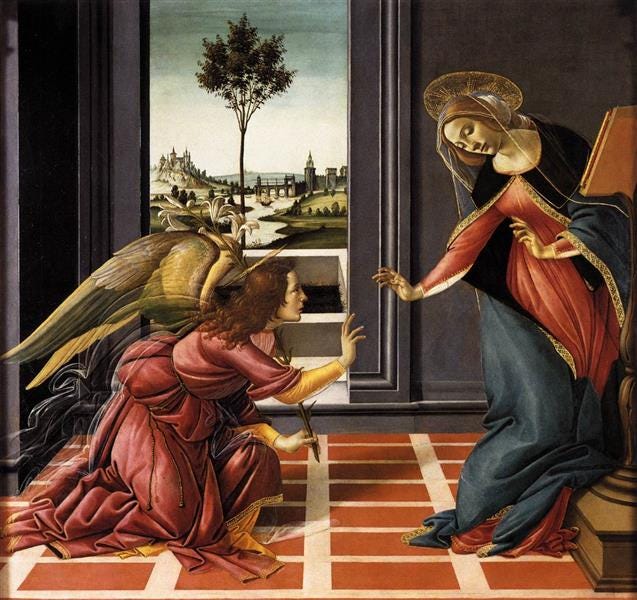
Speaking of beholding and the virtues that make it possible, the Botticelli Annunciation I discussed in the lecture illuminates Mary’s receptivity to the Word of the Lord and her interior silence utterly. All the truly great paintings of the Annunciation capture in a particularly gripping way the virtues of reverence and receptivity. Another reason I wish I would have encountered Ross earlier is her discussion of annunciation as a larger spiritual pattern, where annunciations are something like epiphanies—
“Annunciations leave us with a sense of strangeness, for we cannot wrap our minds around what has happened. They cannot be circumscribed by concept or by the self-reflexive interpretation we call experience. They are too wonderful, they are beyond what we can ask or imagine, and in their wake life will never again be the same. Yet by welcoming this homely strangeness of God in beholding, we learn to welcome the strangeness of our neighbor, and, indeed, the strangeness of ourselves.”
There is a flip side to all of this that I would like to develop further at some point—as we grow in our ability to revere and receive beauty, we simultaneously grow in our capacity to recognize what is ugly. If we behold in silence, not just an exterior silence, but an interior silence, which is itself expansive and luminous, then we will begin to see how noisy and cacophonous much of the world is. Images especially are noisy, noisy with garish colors, with overdrawn features. But we are so deaf, we do not realize that such images practically scream at us. (I recognize the collision of the senses of hearing and seeing, but if Israel saw a voice at Sinai, as Exodus relates, then the mixing of the senses is not only justified but almost necessary.) They are noisy, but not just that. In fact when we recover even just a little bit of silence, even just a little bit of the capacity for beholding, we will begin to see just how ugly many of these images are.
It was a real treat to give this talk, but the real pleasure for me was the chance to hear my friend Seth Wieck talk about poetry. You can see his talk here:
For more on reverence as a virtue, see this piece I wrote a while back for Mere Orthodoxy. In that piece, I discuss Dietrich von Hildebrand’s presentation of reverence as a virtue in his book The Art of Living. For the the talk I gave, I dipped back into von Hildebrand’s Aesthetics, where he also discusses reverence as virtue, but as it relates to the ability to perceive beauty.
A meh novel and some theology about beauty and technology (shocking)
A Fountain of Infinite Light: Jonathan Edwards for the 21st Century, George Marsden
I am slowly making my way through Marsden’s biography of Edwards, and I listened to this shorter book recently because I was particularly interested to hear Marsden’s distilled thoughts on the theme of beauty in Edwards. This shorter work does a great job of taking some of the broadest themes in Edwards, defining them and then applying them to our current context.
I find myself drawn to Edwards right now for a few reasons. From a historical standpoint, Edwards is interesting because he is one of, if not the greatest, theologians America has ever produced. Not only that, but given the upcoming 250th anniversary of these United States, he lived just before the American Revolution, and so his time and his place and his own experience of colonial life stake that period in the particular life of a particularly fascinating individual. I have found biographies to be the best way for me to get a sense of a historical period. I’m also in awe of Marsden’s ability to marshal so much material and to shape it all into a compelling narrative.
From a theological standpoint, Edwards is interesting because he is one the great theologians of beauty. Beauty was a central and abiding concern for him, in a way that often gets obscured by most popular accounts of his theology. Marsden foregrounds Edwards’ obsession with beauty, both the beauty of creation and the beauty of the Lord, in both the biography and in this shorter work. From a pastoral standpoint, I find Edwards insights into the religious affections and into the nature of Christian love to be helpful in a how I think about growth in the Christian life. Just on the basis of Religious Affections, Edwards’ insights into the movements of the human heart place him at the highest echelons of theologians of the human heart.
Vigil, George Saunders
The oil tycoon K.J Boone is on his death bed. Throughout the book, Boone is visited by a series of ghosts, who all attempt to help Boone take responsibility for his life and the negative impact his work, and his denial of that impact, has had on the world. We move in and out of his memories, but it is the lead ghost, Jill “Doll” Blaine, who is the narrator of the book.
Jill has her own reckoning to do with her life, and for me, the twenty or so page run in the middle of the book where Jill flies away from the death bed and towards the life she remembered in Indiana, were by far the most interesting and compelling pages of the book. That said, as a whole, the book did not work for me. But it may work for you. At only 192 pages, it might be worth taking a chance on. There is a certainly a wildness and boldness to Saunders’s writing that I admire, and given how flat a lot of contemporary fiction can be, those qualities have a lot to commend them.
Simply Trinity : The Unmanipulated Father, Son, and Spirit, Matthew Barrett
I read this book alongside a couple of ordinands who needed some remediation in their understanding of the Trinity. Barrett does an excellent job of providing a historical/classical understanding of the Trinity, while also articulating some of the dangers and excesses of social trinitarianism and those who hold to what is called eternal functional subordination.
Now that Barrett is an Anglican, reading this book retrospectively, I can see his own wrestling with the relationship of tradition and the Scriptures. In a way, even though this was written and published before he became Anglican, you can see in his handling of that dance with Scripture and Tradition, with Scripture always taking the lead, why he would find a spiritual and theological home in the Anglican tradition.
Monologion and Proslogion, Anselm
The reading selection for our philosophy club. Whatever you might already know about these works, let me say this—both these works are so much more than arguments for the existence of God. They are meditations. They are prayers. They are demonstrations of the monastic mind working, reasoning, seeking, praying at the very highest levels. Even for those who might find the so-called ontological argument unconvincing (theists and atheists alike often find the argument unsatisfactory), these are worth reading because they demonstrate what faith seeking understanding looks like in action. They demonstrate that seeking. They model that seeking, and here is the spoiler—faith seeking understanding is saturated in, and at times, indistinguishable from prayer. My older Penguin copy of Anselm’s Prayers and Meditations reflects this typographically by setting the prayers as prayers so that they look like poetry on the page.
My book has a long section on Anselm and prayer as well. Balthasar saw Anselm as a theologian of glory whose distinct theological style emerged from his prayer. You’ll have to read the book to see how I use Anselm to critique Balthasar a bit on the subject of prayer, but I will say personally that I now this prayer in the front of every notebook I have:
“O Lord, my God, teach my heart where and how to seek you, where and how to find you.”
This section from the Proslogion will prove important in my upcoming reflection the voice of God as elusive:
“Still, Lord, you hide from my soul in your light and beauty, and therefore it still lives in darkness and mystery. I look all around, but I do not see your beauty. I listen, but I do not hear your harmony. I smell, but I do not gather your fragrance. I taste, but do not know your savour. I touch, but do not feel your yielding. For, Lord God, it is in your own unutterable manner that you have these things; you have give to what you have created in a manner in which can be felt, but the senses of my soul have been hardened dulled, and blocked by the ancient sickness of sin.”
The Way of Excellence, Brad Stulberg
I heard Stulberg interviewed on Cal Newport’s podcast, and their conversation intrigued me enough to take the time to read the whole book. What caught my ear was Stulberg insistence on the difference between excellence and efficiency. Excellence is often inefficient, and yet our broader world, and especially what we call the knowledge word sector, holds up efficiency as its own end. (See the next entry for more on this question of efficiency.)
Excellence in any dimension of life requires intentional practice. So one implication is to treat things that matter to you like a craft and seek explicitly to get measurably better. But you can only do this in a select few areas of your life, so a flipside to the pursuit of excellence is the reality of trade offs. Excellence takes time and investment, and so we cannot, as limited, time-bound creatures pursue excellence in all things.
Two other important things I took from this book. There is a lot of talk online about “flow” and working from a flow state, but Stulberg articulated the dark side of flow, which he calls “shitty flow.” Shitty flow is what happens when we get sucked into doom scrolling or into an endless cycle of digital hits. Stulberg argues that those digital loops can mimic certain aspects of what flow feels like neurologically, but because these loops don’t lead to excellence and because we often feel bad after we engage in them, they are in fact “shitty.”
Final thought—excellence need not mean single-mindedness, so Stulberg insists that we all make sure the house of your life has multiple rooms. What this means
Presence in the Modern World, Jacques Ellul
This book was the selection for Public Theology at our church this past Spring. So we have a series of four conversations about the book. We spent a lot of time talking about Ellul would make of digital technology, generally, and things like social media and AI specifically. That technique is way of viewing and interacting with the world
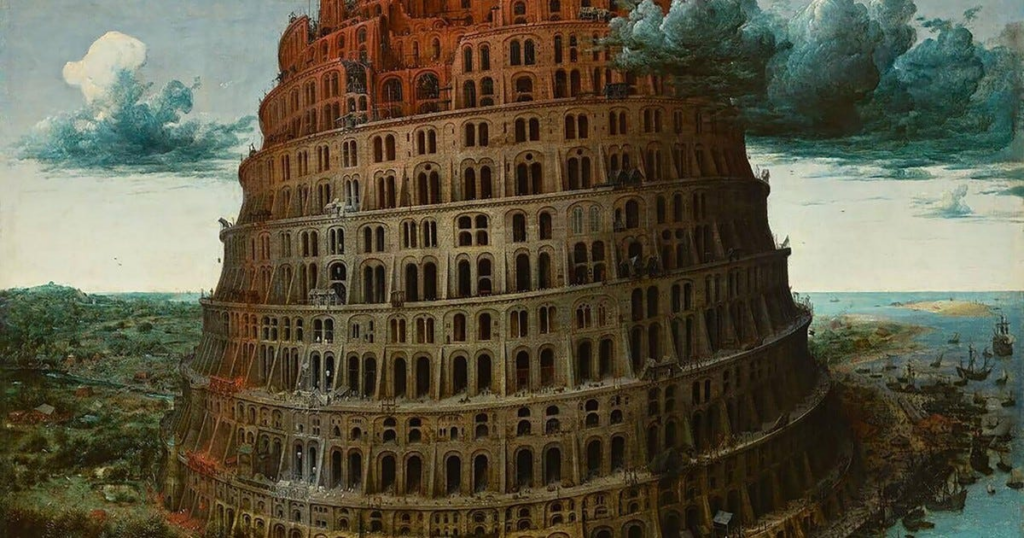
Having finished reading this and discussing it just weeks before the release of the new encyclical Magnifica Humanitas, I cannot help but notice the overlapping concerns of Ellul and Pope Leo. Ellul has an extensive discussion of end and means and of communication, which he frames in terms of Babel as well. What is astonishing about Presence in the Modern World is that Ellul originally published the work in 1948. Ellul had no sense of what would happen with digital technologies or understanding of what the internet might do to supercharge some of his concerns, and yet much of his critique and analysis remain relevant.
Why is this the case? Because while the specifics of technology do change, the underlying logic of what he calls technique does not. Technology is the logic of technique, and the logic of technique says what matters most is efficiency. But when efficiency becomes the only motivating factor then means become their own end. The loss of a true end, a goal, a telos means that the logic of technique becomes a closed-loop and a self-perpetuating myth that says, if we can do something we should do it simply because we can.
In one sense, and to take on board some of Pope Leo’s framing, these questions are as old as Babel, and Christians have spent a lot of time wrestling with these questions. Leo, as an Augustinian, invokes The City of God and the questions of who and what and how we love must be the theological bullseye in our reflections on technology.
the voice of the Lord is full of majesty.” Psalm 29:3-4
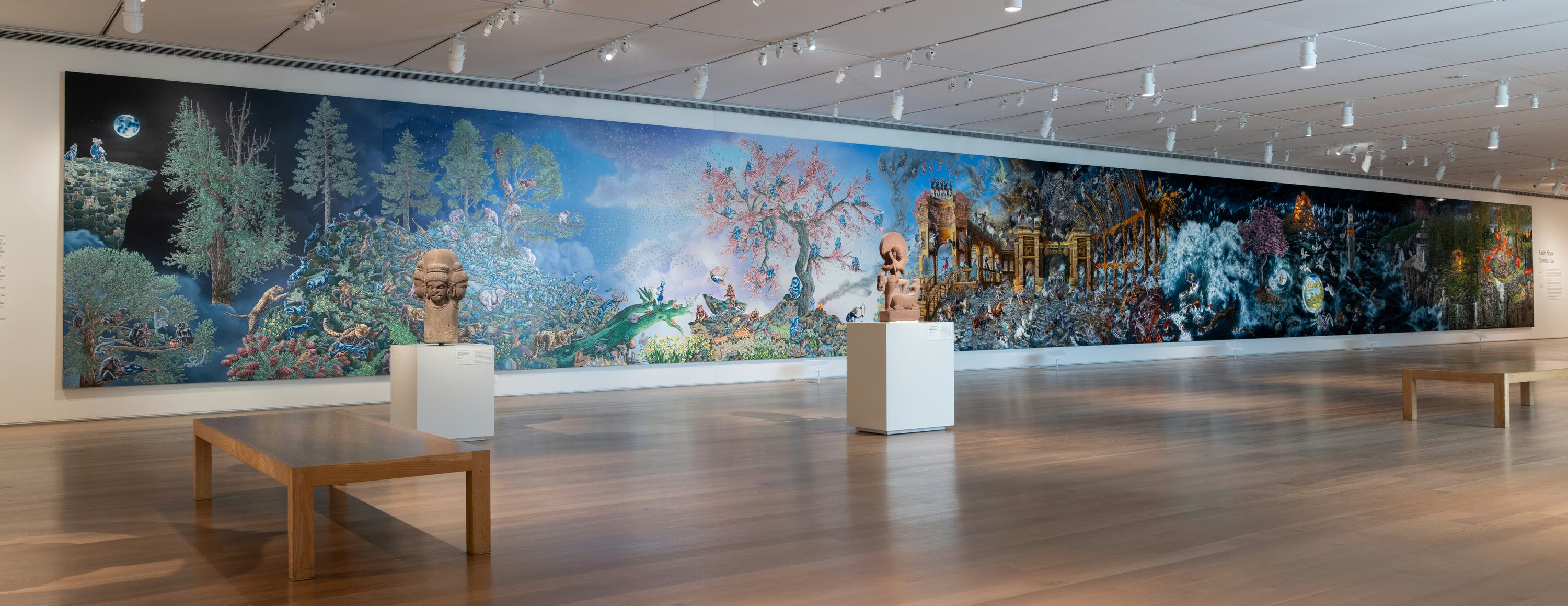
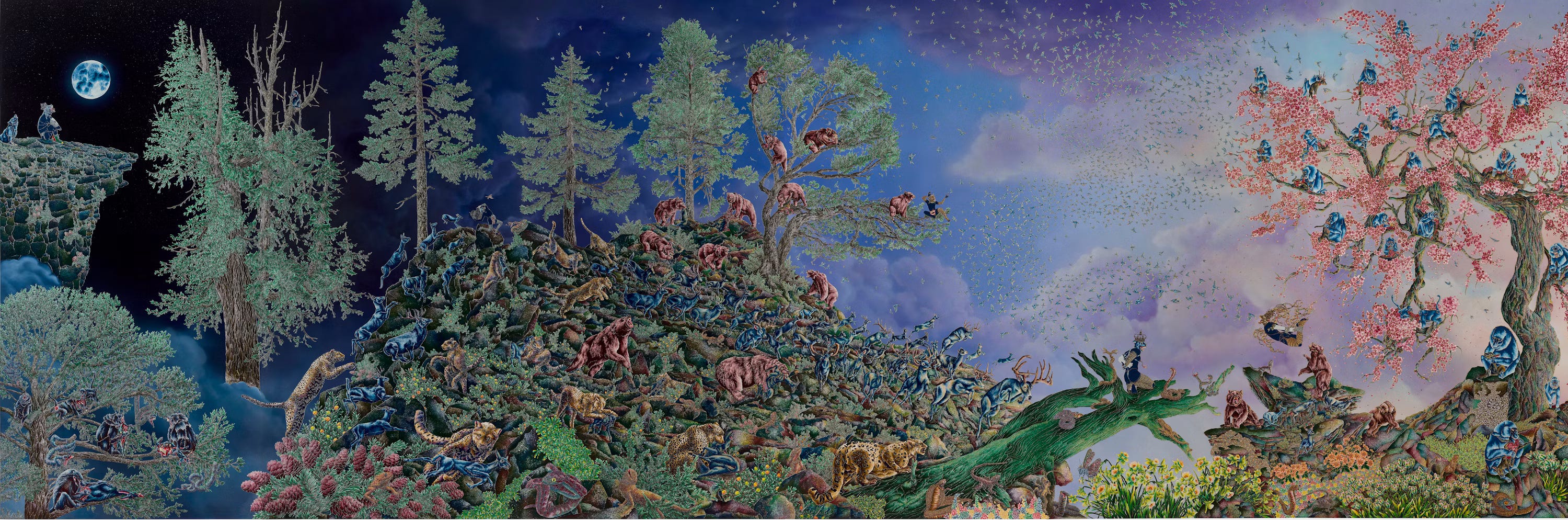
Last fall at the Art Institute of Chicago, I stood in front of an awe inspiring painting by Raqib Shaw called Paradise Lost. I say I stood in front of it. In actual fact, the painting stood in front of me. Spread over at least a hundred feet, the twenty-one panels of canvas jutted against each other give the effect of a single painting. My eyes could never take the whole thing in at once, and yet standing before it, I nonetheless had a sense of its wholeness, of its integrity.
The painting’s physical scale matches the scope of its thematic vision. The painting contains within itself a whole symbolic world, its own bestiary, its own mythology, its own sense of fall and of restoration. Replete with personal symbolism, the painting is nonetheless an overflow of Shaw’s cultural heritage, indebted to the flora, fauna, mythology, and symbolism of his native land of Kashmir. The painting portrays an exile, the personal loss of paradise nested within a sense of universal loss. Shaw bears witness to a lost world, which may at first be a world within himself, but is nonetheless the world as a whole.
“Above all, Paradise Lost is an offering to beauty. And not beauty as ornament, but as necessity. I believe deeply that art has the power to transform sorrow into meaning, and it has this wonderful quality to alchemize personal pain into something luminous and enduring. In a time where attention is fleeting and meaning often feels fractured, I do hope that this work invites the viewer to slow down and to look carefully and to feel without haste.” —Raqib Shaw, artist, painter of Paradise Lost
As an offering to beauty, the painting is an act of love. 1 It is an effusive overflow, an abundant response to the abundance of the world. Abundance begets abundance, and this is the grace upon grace of great art.
What we consider truly great, what we come to see as masterpieces, have this quality of abundance. A classic or masterpiece, Hans Georg Gadamer observes in Truth and Method, is that which always has more to give. One can encounter a masterpiece again and again and yet there always more to receive. Those who follow in Gadamer’s wake extend this concept and speak of an abundance of meaning. Paul Ricouer calls it excès de sens (excess of sense), while David Tracy, in a theological context, calls it the surplus of meaning. No matter how many times you return to the classic, no matter how many times you sit with a masterpiece, there is always more there there.
The VOICE of the Lord has this quality as well. This abundance is the effusive quality of God’s VOICE.
While Psalm 19 is the psalm of allusion, Psalm 29 is the psalm of effusion. Represented as a raucous thunder storm, the effusive voice of the Lord thunders, breaks, bends, blows, shakes, strips, and makes the deer give birth.
In response to the thunderous VOICE, in Psalm 29 all those in the temple can simply cry “Glory!” There is something childlike in simply saying, “Glory!” in the face of such abundance. Those assembled are not dumbstruck, they do not keep silence, but they are reduced to a seemingly limited vocabulary. And in this way we and the angels and all of creation are always and ever children, for the glory of God is ever more, and we all exclaim, “Again! Again! More! More!”
Though it is only a single word, the cry of glory is theologically and doxologically profound. The logic of glory, the glory of the Lord, calls forth worship, an acknowledgement of glory. It is the glory of glory to be praised, and so we with the angles call out “Glory!”
Glory is our depth crying out to his depth, deep calling to deep, so glory as a word all its own names something of the effusive nature of God, and certainly the abundance of divine revelation. Doxology is literally the logic of glory, and the logic of glory, is the ever-more of God. Glory is the splendid and brilliant weightiness of God, the ever more and beauty of his being. To say “Glory!” is to not simply acknowledge this effusive excess, but to praise God for it. And what theologians as diverse as Augustine, Anselm, Jonathan Edwards, Hans Urs von Balthasar, and Karl Barth have understood is that to call God glorious is to call God beautiful.
If Beauty is indeed a name for God, then Beauty does in effect not only demand but deserve an offering. We speak glory back to the Glorious one. Which takes us back to Psalm 19. Creation leads the way once again. The creation which speaks glory back to the glory of the Lord, so that “day after day pours out speech.” Here the speech flows like a spring, a spring sourced from the deep, that flows and flows and does not cease to flow, that pours and pours and does not cease to pour. Though in one sense the speech is silent, it is nonetheless abundant, overflowing, unrestrained, effusive. So abundant as to be almost embarrassing. And what is this speech saying? Glory, glory, glory.
If there is more and ever more to hear, then one cannot seek total comprehension. The goal can never be mastery. Rather it is to be mastered, to be swept up in the child-like wonder that there is more and ever more, both within and without. The effusiveness of the voice of the Lord offers a parallel to the experience of truly great art. There is the subjective sense of being deepened by what is deeper than us, the sublime sense of being overawed. Some may find such experiences paralyzing, and they can certainly be overwhelming, but such experiences can lead to a desire to grow, can open up a desire within to in a sense become capacious enough to receive more of the depths. When one stands in front of a truly great piece of art, it is often not a question if deep calls to deep, but whether or not, when the deep calls there is any depth within than can answer back.
There is a way to read those words in idolatrous terms, and that is a dimension of this approach that I will need to address in a post of its own.
“Exposure to the freely given and immeasurable outpouring of divine light relaxes the mind’s self-defeating grip on its own small certainties” Mark McIntosh, Discernment and Truth: The Spirituality and Theology of Knowledge
“He is not unwilling known, but only (if so) unwilling that, knowing him, we should attribute the achievement to ourselves.” Austin Farrer, The Glass of Vision
I was once talking about the voice of God with a podcast host, and he made an observation that didn’t make it onto the recording. After I had shared my story, he said, “You are very hesitant to say, ‘God told me…’ Instead you say things like ‘I felt like God said’, or ‘I had the sense that God was leading me.’”
He is right. I have always been reticent to say in any unqualified way, “God told me X.” Part of this has to do with my temperament. I am by nature a cautious person and speaking on behalf of the Divine makes me, and I think rightly so, a bit nervous. But part of this has to do with my upbringing. I grew up in a charismatic church where people were all too happy to say, “Thus saith the Lord.” They spoke, it seemed to me then, with the authority and cadence of the King James without any trace of blush on their cheeks.
It was the idea of a VOICE that tripped me up. In all likelihood, my mind was too literal (my parents have certainly said this was the case). I thought that VOICE meant voice, meant audible sound. If voice meant voice in this way, and I never heard a voice, then I never heard God. By extension I doubted that others did too.
Beyond that, I do know that I was overly scrupulous, terrified of getting anything wrong, so how might I dare to speak on behalf of God? Which makes my being a priest deeply ironic. As a preacher, I have confidence, whether it’s justified or not, to say “This is what God’s word says.” Speaking for God in this way has always felt different because there was a basis of agreement that the Bible was God’s word. In the context of corporate worship, I am always trusting that the Spirit is at work through the reading and preaching of the word, despite my best or my worst efforts. Even though I am preaching, the Scriptures themselves and the Spirit who not only inspired the Scriptures, but who illuminates them to the people of God, do the heavy lifting together. At least this is what I tell myself. I try to bear my contradictions lightly.
But what I’ve come to realize—it wasn’t just that my understanding of VOICE was too literal. My understanding of listening was too. Before I could have any chance of hearing God, I had to learn how to listen. If voice didn’t mean VOICE, then maybe listening meant something else too. I had to learn how to listen, and in my life, it was learning about and encountering art that taught me how to listen.
The teacher who first exposed me to art and to the art of listening was a grump, a curmudgeon by any standard, and almost impossible to please. He was also available to his students in a way I had yet to experience in school. So while he tore apart our writing with a potent mix of disgust and glee, he always made himself available to read our drafts line by line.
He called it Wendy Works. A week before our papers were due, he would post himself in a booth at the local Wendy’s and then proceed to read our essays line by line. And you had to sit there and watch him do it. As he read, he would sometimes wince at an unsupported claim. Every instance of the passive voice landed like a body blow. He would pour every ounce of his displeasure onto the page with furious swipes from his red pen. But our writing was better for it. We were learning how to take our own thoughts seriously because he took the right expression of our thoughts so seriously. He taught us in word and in deed that the translation of thought to page was a battle. We had to wrestle those thoughts to the page, which was itself an act of listening—listening first to our subject, but also listening to our writing, even in its nascent form, to learn what it might be trying to say.
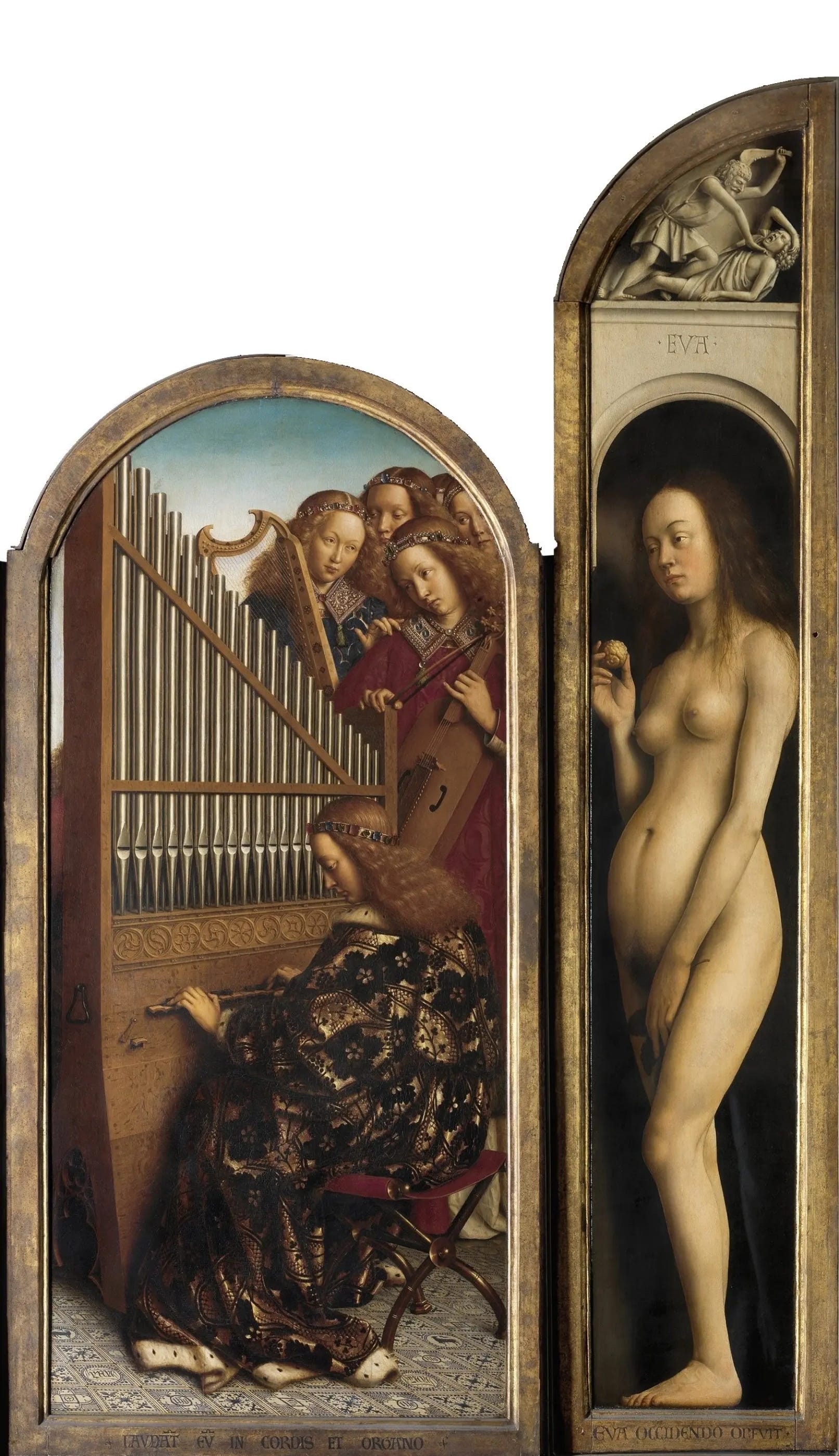
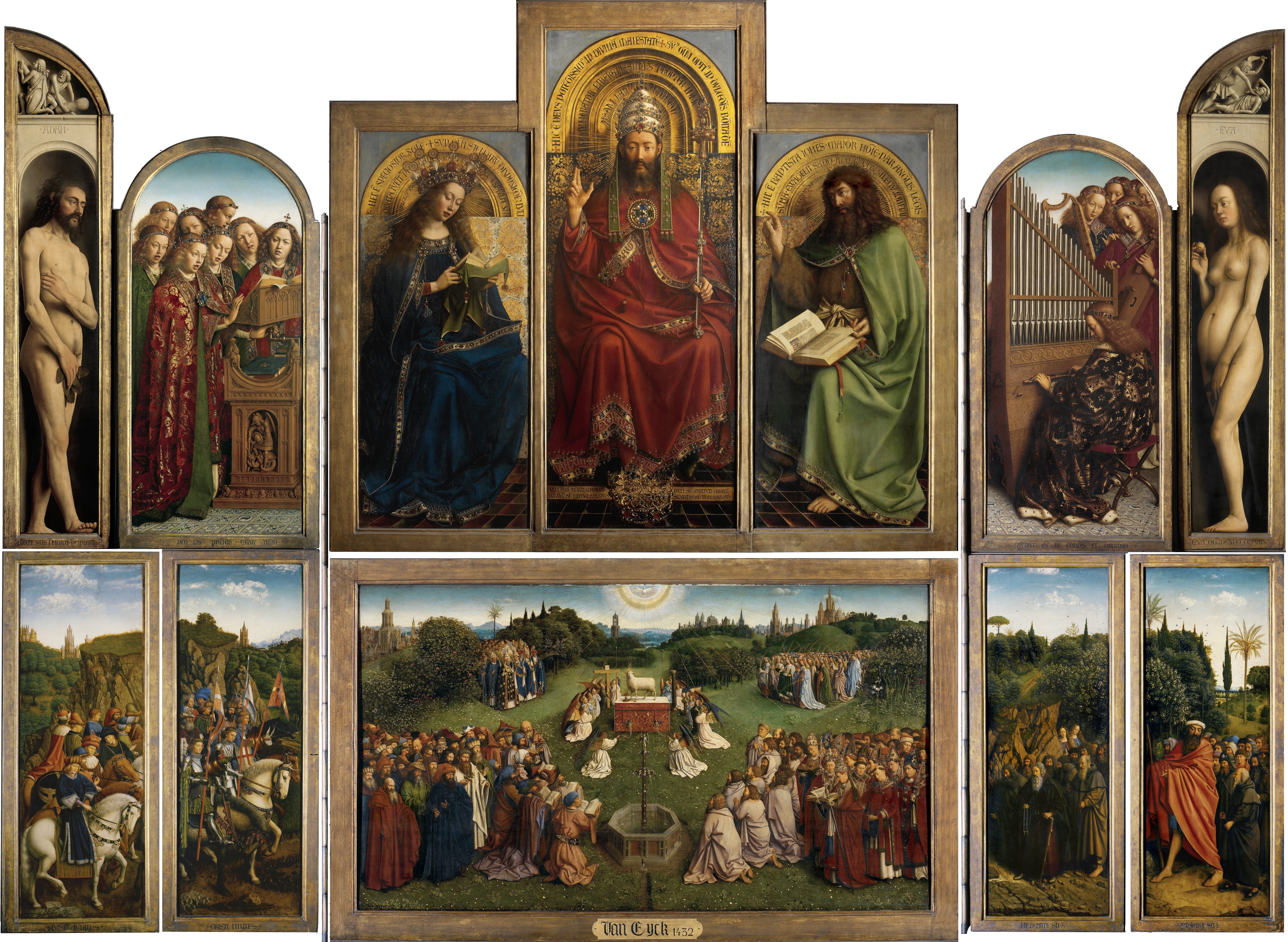
In addition to teaching American Lit, he also taught a senior level Humanities course. And for me this was a world of wonders. We spent our class time pouring over the great works of Western culture—paintings, sculptures, buildings, symphonies, epics, novels. It was the study of painting in particular that opened my “ears” to listen. The lights would go out, and we would work through a carousel of slides, filled with pictures he had taken himself of the great masterpieces of the world. I especially remember the up close shots of Jan van Eyck’s “Adoration of the Mystic Lamb,” the impeccable, almost imperceptible brush strokes, the sorrow of Eve’s face as she held her pregnant stomach, her gaze directed somewhere else and then, next slide, in the grandeur of the full altar piece, we traced the downward angle of her gaze to behold what she beheld, the mystic lamb at the center of it all, slain from the foundation of the world.
And that was one lesson on one day. Day by day, slide by slide, I was initiated into the world of art and into the art of perception, of paying attention, of learning to see and to hear. This mode of perception, this slow, contemplative world, was what I had not yet learned about hearing the voice of God, that it too was as much an art as a science, and that growing in it required a master teacher too, someone skilled in discernment, someone who had learned to listen and look well, standing next to you, looking and listening along with you, helping you learn what to pay attention to, what to ignore.
When it comes to understanding the voice of the Lord, such instruction, I realize now, was available to me. I could have asked what those who spoke of hearing the voice of the Lord actually meant. I could have asked to be trained in the ways of spiritual listening. There were people who would have been not only been glad to guide me but equipped to do so. What I realize in retrospect, is that when you ask people about what they really mean by the voice of God, then you will quickly come to understand that impression, intuition, and instinct play enormous roles in this kind of listening. But these things—impression, intuition, instinct—were things I first learned by attending to beauty in art. I realize now that for most, the declaration of “Thus saith of the Lord” was not necessarily disingenuous or performative, but a phrase that summarized a dynamic process.
As it happened for me, my humanities teacher initiated me into this kind of listening. By first learning to listen to art, I came to understand three things about the VOICE of God. The VOICE of the Lord is allusive, effusive, and elusive. It is allusive because the voice of creation speaks of the glory of the creator, effusive because it is everywhere all at once all the time, and elusive because it can at times be hard to find and hard to hear. The three characteristics parallel three dimensions of learning to listen to art and to beauty more broadly. In the next few posts, I plan to take up these three characteristics in turn and to tease out what I came to understand about beauty and about the VOICE of the Lord.
“Wherever you look, God’s symbol is there; wherever you read, there you will find His types. For by Him all creatures were created, and He stamped all His possessions with His symbols when He created the world.” Eprhem the Syrian, Hymns of Virginity (20.12) \
In part one of this series, I reflected on the role that learning to “listen” to art played in my life and how it helped me grow in my understanding of the voice of the Lord. And I wrote about the special role teachers play in helping us grow in our perception, spiritual or otherwise. I had such a teacher. He would stand next to us, as we looked at art together, and say, “Here is what I see. Here is what I hear.” His perception and guidance was an invitation for us to first see what he saw and to hear what he heard. At first I could not see it or hear it. At first all I could do was want to see it. And that desire was enough, a place to begin.
Growing in such perception is related by analogy to our perception of God, a point I learned from another one of my master teachers—Hans Urs von Balthasar. Balthasar, the great 20th century, Swiss Catholic theologian began what became a theological trilogy centered on beauty, goodness, and truth, with the question of beauty, which he framed in terms of theological aesthetics. The aesthetic has to do with perception, with what is sensible, so the perception of God is not the worst gloss on theological aesthetics. But how is such perception possible? How does one grow in it? Before answering how one grows in perception of God (as in listening to the voice of God), Balthasar asks a more basic but related question—how does one grow in perception generally. He turns to the example of perceiving art, and says it is through “the mediation of a great teacher” that one can “glimpse the uniqueness of a work of art” (Convergences, 52). One can learn to see through the eyes of another. One can learn to hear through the ears of another.
Throughout the multiple volumes of his great work The Glory of the Lord,Balthasar draws an analogy between the beauty of the world and the glory of the Lord. One implication of this analogy is that like the beauty of the world, God’s glory must be perceived. But in order to perceive it, we must be initiated into the reception and perception of divine revelation. God does speak, does have a voice, in other words, but one must become the kind of person who is able to hear it. I said at the end of the last essay that I wanted to draw out three aspects of the voice of the Lord that have analogical parallels to art. The voice of the Lord is allusive, effusive, and elusive. Let’s start with allusion.
Allusion may be most familiar to us from a literary context, which for me became entirely the point. The OED glosses allusion as “a symbolical reference or likening: a metaphor, parable, or allegory.” The literary application of allusion in particular helped me unlock something key about the voice of the Lord. The unfurling web of allusion unfolds as an ongoing, ever renewing conversation. One might begin, say, with Dante, only then to trace the simplest line of allusion from him back to Virgil and from Virgil back to Homer. The visual language of painting is also allusive. Again to trace a relatively simple example, Caravaggio is in conversation with Michelangelo, so that his visual language is in allusive conversation with his predecessor, and Michelangelo is in visual conversation with Giotto, whose own immersion in the world of Scripture establishes a basic visual vocabulary for the Italian Renaissance. Again this simple line of allusion does not even begin to deal with the sources of their paintings, the scriptures, the teachings of the church, the myths, which are themselves in constant allusive conversation with each other.
And the scriptures themselves are their own web of allusion, which endlessly fascinates and sometimes entangles us. Even that web is nested within another web of allusion—the creation—which speaks to itself and back to its creator, declaring the glory of the Lord. And this is what I mean when I say that the VOICE is allusive. If indeed “the heavens declare the glory of God, and the sky above declares his handiwork” (Psalm 19:1) then the voice of creation sings back to the VOICE that first spoke (sang) it into existence. This reciprocity, this dynamism of the gift giving praise back to the Giver, opens an entire environment of communication wherein the whole of creation becomes a medium for the praise of its Creator. Creation is an allusion to its Creator.
Creation is an allusion to its Creator.
But this singing back is paradoxical. What is the nature of the voice of creation? Here the same Psalm is ambiguous. Some translations have it that the voice of creation speaks without speaking; it is a voice that is voiceless. “There is no speech, nor are there words; their voice is not heard; yet their voice goes out through all the earth and their words to the end of the world.” (Psalm 193-4, NRSV). What is that message? The declaration of glory. How then do we understand this voiceless voice? They are voiceless in that they do not speak of themselves. They speak of the one who spoke them into existence. This is the deepest kind of voicelessness. It is not an oppressive silence, but the allusive abundance of creation speaking of and back to its creator.
There is another way to take this verse in Psalm 19, however. Alternatively, some manuscript traditions, and the LXX seems to follow this tradition, describes not the silence of the voice, but the superabundance of it—”There are no speeches or words, in which their voices are not heard.” Meaning, it seems, that all that is cannot help but declare the glory of its creator. Whether these are silent voices or superabundant ones, their sounding is a response, an allusion to their originator.
Whether the voice is voiceless or superabundant, if creation articulates the glory of God, then the voice of the glorious God proclaimed must bear some relationship to the voice that speaks of Him. It wasn’t until I could think of God’s voice as a voice analogically, that I really began to understand what people might mean when they said they heard God’s voice.
What is allusive is also effusive, abundant.
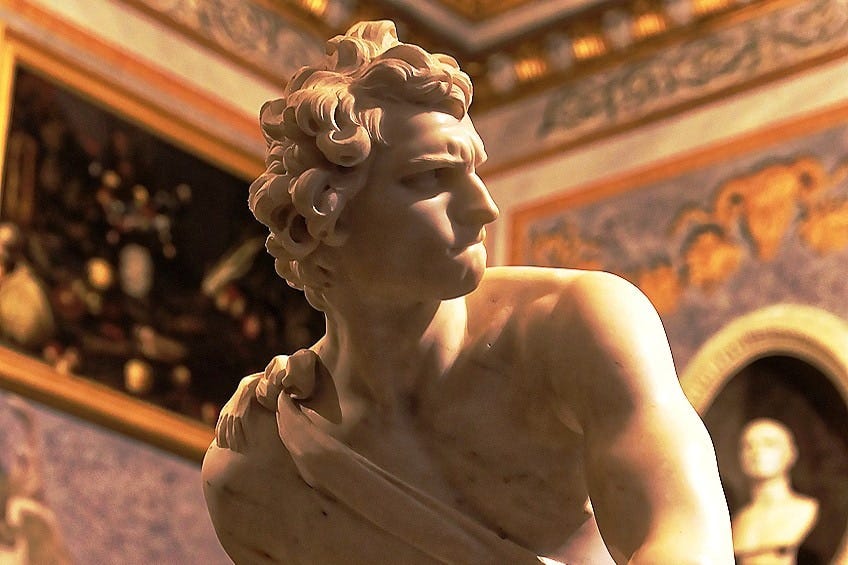
Learning to catch an allusion here, an allusion there is the way any of us are initiated into a new language, a new vocabulary for a whole interconnected web of conversation and meaning. When I first saw those great masterpieces and read those great works in high school, what did I as a seventeen year old kid glean from these monumental works? What did I really see in those paintings? Or really hear in those symphonies? Or really understand from those books? Hard to say, but I was left then and am really left now with a set of indelible images—Ahab nailing the golden doubloon to the mast of the Pequod; a turtle lumbering across the highway in Grapes of Wrath; the downward gaze of a pregnant and bereft Eve; Dante emerging from the depths of hell to see the stars once again; the torsion in David’s body, the biting of his lip as he was just about to unleash the felling stone from his sling.
I was left with these indelible images and many more. I wanted more such images, more such encounters. This longing was intuitive, an instinct that this world has more and more and more to give. What is allusive is also effusive, abundant. Job, more than most, maybe more than almost any, knew such abundance can come at a cost—“Behold, these are but the outskirts of his ways, and how small a whisper do we hear of him! But the thunder of his power who can understand?” (Job 26:14) There is, then, a bridge between the allusive voice and the effusive voice, which we will turn to in the next essay.
Part memoir of growing up an anxious pastor’s kid in the evangelical and segregated south, part reflection on the role therapy played, especially Freudian analysis, in unwinding Marsh’s evangelical anxieties, and part theological reflection on the uneasy relationship between Jerusalem and Vienna, I found this book intensely readable, compelling, and challenging. That being said, many may find some of Marsh’s Freudian frankness off-putting, but some of that shock is by design. Marsh invites us into the path he walked towards seeing in himself as a creature who had real desires. His account names something important about the weight of being an evangelical subject, and he comes to recognize that there was “something profoundly solipsistic about the formation of my evangelical ego.” His experience with analysis in particular allowed him to be “released from the heavy weight of the Protestant evangelical subject.”
In one of the more theological sections, Marsh discusses possible Christian appropriations of Freud and points to Paul Ricouer’s reflections on Freud. As Marsh relates, Ricoeur argues in The Future of Illusion that “Freudian psychoanalysis prepares the mind for a faith cleansed of idolatry—to apprehend the God beyond god” What does this process involve but “disentangling the reality from the symbol, of freeing the transcendent mystery from the domesticated word.” However, “The question remains open for everyone whether the destruction of idols is without remainder.”
John and Paul: A Love Story in Songs, Ian Leslie – I listened to this one and enjoyed both the book and the narration. Though the book does outline the career of the Beatles, it is much more than a biography of the band. The centerpiece of the book is John and Paul’s relationship and the songs they made with each other, for each other, in response to each other, and at times even against each other. John and Paul’s relationship as Leslie presents it is more than a friendship, certainly in the anemic terms we tend to think of friendship these days, but less than a love affair. Even so, as Leslie I think shows, their creative relationship, at times cooperative and collaborative, at other times competitive, certainly has many of the markers of a kind of romance. This is what Leslie is trying to get at—their friendship seems strange to us not because it it is strange (though it had an outsized intensity and an impact) but because we have lost the category of this kind of friendship. In this way, the book was deeply Aristotelian without intending to be so in any conscious way. It’s about friendship and excellence and community and the generationally defining, alchemical ways all these things combined to give us the Beatles.
King, Warrior, Magician, and Love Robert Moore and Douglas Gillette – Yes, I am turning 45 this month, and yes, I am doing a fair amount of reading around questions related to the second half of life. But I didn’t really need that excuse to dive into some good old fashioned Jungian work around the male psyche. If you have a problem with that, you can take it up with my high school English teacher, Mrs. McFarland, who taught us about archetypes and the hero’s journey by showing us Star Wars.
On the topic of the hero’s journey, Moore and Gillette make the point that the hero’s quest is part of boy’s psychology and though necessary for the transition from boyhood to manhood, should not remain a point of fixation going forward.
For better or worse, I find the Jungian framework and the archetypes to be deeply compelling and to be a framework that does help me conceptualize different aspects of the psyche. And that in itself makes a kind of reflection, and dare I say, dialogue with oneself possible in a way that some other approaches just don’t.
That being said the authors too naively accept some of Jung’s more notorious criticisms of Christianity. I will have more to say about that once I finish a book in progress from John Sanford, who was an Episcopal priest and Jungian analyst. His commentary on John, Mystical Christianity: A Psychological Commentary on the Gospel of John provides a helpful (but certainly not the only possible) Christian reception of Jung.
The Way of the Disciple, Erasmo Leiva-Merikakas
Meikakas is to my mind one of the truly great practitioners of lectio divina. The magisterial fruit of his contemplative reading is his multivolume commentary on Matthew, The Fire of the Word. (If you want a sense of how he thinks about lectio divina, this essay outlines his approach.) The Way of the Disciple is more approachable, but no less deep than the commentaries, and offers rich reflections on different aspects of what it is to be a follower of Jesus. To follow him, we must be as clay in his hands, constantly made and remade in his image. Lectio divina, especially the way Merikakas practices and models it, is a means by which we place ourselves in the potter’s hands.
Dependent Rational Animals, Alasdair MacIntyre – If you ever thought that what was missing from discussions of virtue ethics was expansive reflection on the inner life of dolphins, then this the book for you. Not just dolphins mind you, but dolphins qua dolphins because this is philosophy, dammit.
Speaking of philosophy, this was the reading selection for a philosophy club I am part of. I had suggested this book to our club because we wanted to read something in the wake of MacIntyre’s death and had already engaged in a rousing discussion of After Virtue. Dependence, rationality, and animality, as the title suggests, are all entangled aspects of what it means to be human. At the heart of this book is a paradox that true human independence, which is necessary for human flourishing, is itself dependent upon interdependence. It is community that makes independence possible. And more than that MacIntyre’s wants those who would reduce the human to the rational to consider the reality of their animality, and the reality of their dependence on others.
I recently read Karol Wojtyla’s (St. John Paul II) retreat text God is Beauty: A Retreat on the Gospel and Art. Delivered to a group of artists in Krakow during Holy Week in 1962, this set of talks invites the retreatants to reflect on the meaning of the beauty of God, the creative life and process, and the centrality of prayer in the creative life.
It is this last theme that I’d like to briefly reflect on in this post. Wojtyla’s point is not simply that it is important for these artists to pray, but also that prayer itself can be a creative act. He makes this connection around the theme of silence.
Before turning to silence, Wojtyla offers a simple thought about prayer so often forgotten—“The essence of prayer is conversation.” Conversation, of course, requires at least two participants for the requisite back and forth, but conversation also requires silence. Even if only for the smallest sliver of a moment, in a conversation one must, at some point, pause to listen. The lack of the pause, either because of ignorance, or more likely, the anticipated terror that the silence will last forever, often keeps prayer from being a conversation. While the first mistake of prayer is never to begin, the second mistake is to leave no room for a response, no space to listen.
Reflecting on the necessity of silence in prayer, I am reminded of a section in Anthony Bloom’s Beginning to Pray. When Bloom was a newly ordained priest, an elderly woman described a problem she was having with prayer. She told him that she had been practicing the Jesus Prayer for years and years but that she had never gotten anywhere with it. Boldly, Bloom simply asks her if she had ever paused to listen. Instead of only speaking, he suggested, she might try listening.
Though initially offended by his brashness, the woman decides to try it. Here is what she reported back to him. Initially, the silence gave her the chance to appreciate where she was and what she had. The silence gave her space in which to cultivate gratitude, even for what we would call her modest circumstances. Then something else happened, as she slipped deeper into silence:
“I perceived that this silence was not simply an absence of voices, but that the silence had substance. It was not absence of something but presence of something. The silence had a density, a richness, and it began to pervade me. The silence around began to come and meet the silence in me…All of a sudden I perceived the silence was a presence. At the heart of silence there was He who is all stillness, all peace, all poise.”
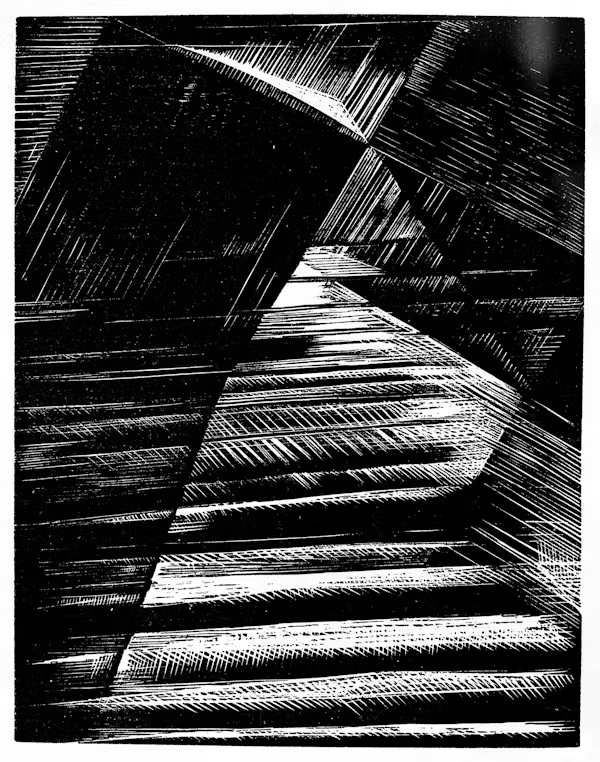
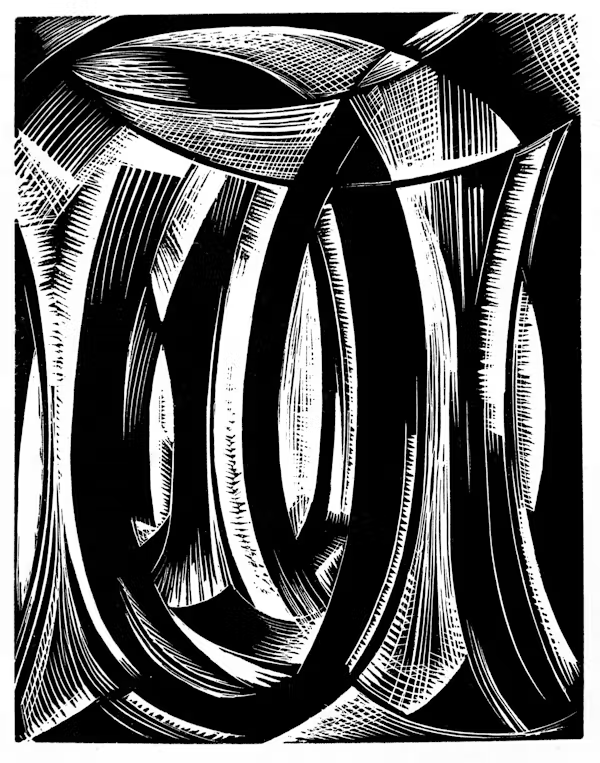
Paul Nash, “Creation of the Firmament”
To connect this back to Wojtyla and the retreat, listening in the way she describes is a creative act, and risky too, like all creative acts, because it involves a kind of surrender of control. It is that fear of surrender that so often keeps us from allowing silence, let alone slipping into silence. If we consider the lack of silence in our lives at all, we are likely to blame those things we believe are unique to our time and place—distraction, technology, busyness—but the spiritual masters tell us that there has always been a deeply human aversion to silence. The fear of silence is the fear of absence, the fear that silence is nothing but void. The woman’s reflection on the power of silence, however, points beyond this fear. To trust in silence is to trust that what seems a void might become a womb.
Wojtyla’s point is that in prayer the spiritual life is birthed in silence and by analogy much art is birthed in silence too. Like Bloom, Wojtyla describes the necessity of listening in prayer:
“Yet prayer is a conversation. Perhaps we don’t have to say so much; perhaps we don’t have to tell God so many of our grievances, but simply listen. What does he want to tell me? Perhaps underneath all of my words, grievances, and regrets there is some issue that he wants to bring to the fore and point to! And that is the turning point! The moment that sometimes determines my entire life! Because if he speaks to me, he is doing so in order that I might become a better person, more similar to him. After all, I am—that is the assumption—similar to him, created in his image and likeness.”
A second observation is that when we treat prayer more like a conversation built on back and forth and on silence, it begins to conform to the shape of worship itself. As in prayer so in the liturgy. When it comes to worship, we don’t start the conversation. We join the conversation. The liturgy is built on this fundamental rhythm, the back and forth of God speaking and us listening and responding.
Worship, like prayer, depends upon the rhythm of conversation. Liturgy, the work of the people, only really works when there is a back and forth, a call and response. The call of the liturgy finds its source in the creative voice of God, in and through his saving acts. All worship, but liturgical worship in an explicit way, moves to the rhythm of back and forth, the call and response, a rhythm sourced by a more fundamental rhythm—God speaks/creates/redeems and his people respond. The praise of creation, and Wojtyla calls this the prayer of creation, is a response to the creative act of God, not simply the first set of “Let there be’s” but the ongoing, upholding, and loving word that sustains creation now.
The Song of the Sea recorded in Exodus 15 is the ecstatic response to what God had done in delivering them from Egypt and through the Red Sea. I mention that particular example because that song may be the oldest bit scripture there is and so by extension may be the oldest strain of liturgy that we have, the first recorded response to the saving act of God. The song was a creative act in itself, the very human desire to praise what is praiseworthy, to craft the language and the rhythm of music in a way that befits what the song sings of, which leads us to a the final observation—Wojtyla insists that work can be prayer too.
As he says, “There is no issue in our lives, there is no activity, there is no effort, which cannot be turned into a prayer.” His admonition to the artists is that they be people of prayer, who enter into the conversation, who practice silence, letting the seeming void become a creative womb, and this too applies to their work. If they will see it in this way, their work too might be prayer because their creativity can be a kind of conversation, wherein silence becomes the seed bed of creativity, and where the work itself is a response to the voice they hear in silence.
Front Porch Repulic recently published a piece of mine called “Where Can Wisdom Be Found? Gambling Pigeons, the Quest for Wisdom, and the Irreducibility of Poetry”. It’s a meditation on Job 28 and what that poem has to teach us about the quest for wisdom by means of its own poetry.
Here’s a taste:
While the search for mere information, raw data, can often be constrictive, the hunt for wisdom is meant to be expansive. My sense is that Job 28 calls us to a larger environment, summoning us to the quest for wisdom in which we will expand the boundaries of our own perception and current understanding. Wisdom is not found in mines, or in the places of the deep, and yet the implied exhortation is to mine for it, to hunt for it, to go in search of it. If we too are meant to be miners for wisdom, hunters for the real thing, how then do we do it? This poem has something to teach us about that quest and so too, I believe, does poetry as an art form. As a beautiful poem in its own right, Job 28 points beyond itself to the power of poetry writ large.
The poem itself performs the very quest it commends, seeking with image and rhythm, structure and rhetoric, for the heart of wisdom. As we have seen, so much of the poem speaks of the quest for wisdom, mining for it, seeking it, learning that wisdom cannot be found where gold and silver are found. While speaking of searching in vivid terms, the poem performs its own searching. Throughout the chapter, our poet speaks of mining and then acts as a miner. This poet, and all great poets, are spelunkers, repelling into darkness armed with little more than a headlamp.
As we were planning the ministry year at St. Bartholomew’s, David+ Larlee and I believed that coming into 2024, we needed some kind of space where we could not only have conversation around important but controversial topics, but also where we could learn how to have those kinds of conversations. It was not enough to have difficult conversations; we wanted to provide people with the tools to have those conversations in distinctly Christian ways.
So, we decided to stage five conversations over five months, using the book The Deeply Formed Life by Rich Villodas as the basis for our conversations. In the book, Villodas discusses what he calls five transformative values: contemplative rhythms, racial reconciliation, interior examination, sexual wholeness and missional presence. As we planned these evenings of conversation, our instinct was that the format of an Alpha evening would provide a structure for the kinds of conversations we imagined having around these important but sometimes difficult topics.
The first principle we took from Alpha: Begin with hospitality. We knew that every evening would begin with a shared meal. We wanted to model conversations where people were “quick to hear, slow to speak, slow to anger” (James 1:19).
The key word from James is “slow.” For things to be slow, we had to let conversation unfold over the pace of a meal.
The inherent slowness of a leisurely meal sets the pace for conversation about topics that cannot be understood at the speed of a tweet. In practical terms this meant that we reserved the patio of a local Italian restaurant so that our table groups could enjoy good food and drink as we engaged in conversation.
Christianity Today published a reflection I wrote for Good Friday about the church as Christ’s wounded body. Here’s a taste:
On Good Friday especially, we turn our gaze to the man of sorrows who bears our affliction. The paradox of our faith is that in his wounding is our healing, so as important as it is for the church to acknowledge our own wounds, it is even more crucial to look at the one who bears our wounds in his wounding.
Christ’s wounds hold not only the promise of our healing but also the mystery of the church’s origin. As the early church meditated on the Crucifixion, they turned their attention to a particular verse, John 19:34, which records that “one of the soldiers pierced Jesus’ side with a spear, bringing a sudden flow of blood and water.”
In meditating on this verse, many in the early church insisted that from the wounded side of Christ, the church was born. Origen (A.D. 185–254) captures this conviction in a potent phrase: “From the wound in Christ’s side has come forth the church, and he has made her his bride.”
The church was born from a wound. The early church saw the last Adam hanging heavy on the cross in the sleep of death, but from his side, his wound, a new Eve was brought forth—the church. Born as we are from that wound, the church journeys with Christ through Good Friday, Holy Saturday, and Easter Sunday. In his passion is our own path and our own healing.