
“The whole of history (is) a concealed witness, a riddle that cannot be solved, without plowing with another heifer than our reason.” Johann Georg Hamann, Socratic Memorabilia
“God is behind everything but everything hides God. Things are black, human beings are opaque. To love someone is to make them transparent.” Victor Hugo, Les Miserables
“The human mind and heart must search diligently and full of awe for the marrow of the Mystery, which can be communicated only in veiled form.” Erasmo Leiva-Merikakis, Fire of Mercy, Heart of the Word: Meditations on the Gospel According to St. Matthew
Over the past few posts in this series, I have tried to describe what I learned about listening to the voice of God by listening to art, and vice versa. Such listening, both to art and to the voice of God, is something that one cultivates because such meaning, as I have written is allusive, effusive, and elusive. In art meaning is allusive because images, plots, characters, symbols and structures, speak to each other in an ever expanding conversation stretching across centuries. In a similar way, the voice of God is allusive because God’s creation resounds with the Voice of its origin, speaking of and back to its creator. In art, particularly in masterpieces, meaning is also effusive, an abundant overflow. While there is stable core, all that a masterwork means is never fixed, never final. So too at times is the voice of the Lord effusive, a voice that thunders and shakes the cedars.
In this post we come to the final shared quality—elusiveness. In art meaning often eludes us, shuddering like dancing light at the periphery, fading as soon as we turn to face it. And so it is often with the voice of the Lord.
This Substack is reader-supported. To receive new posts and support my work, consider becoming a free or paid subscriber.
It is not elusive because it is lacking. Far from it. Elusiveness often has more to do with me, a consequence of my own lack. Of course, one must also say something of divine hiddenness, of the back parts of God, briefly glimpsed as the Lord passes by. Elusiveness might very well protect us from a glory that would not just overwhelm, but would in its fullness annihilate us—as Moses came to know and Isaiah knew as he was undone by the glory of the Lord.

Elijah too knew something of the voice of the Lord in its effusive form on Mt. Carmel, but coming to Mt. Horeb, he has an entirely different experience of that voice. The movement from Carmel to Horeb is the movement from the effusive to the elusive, so it worth reflecting on how Elijah found himself at the mouth of the cave on the holy mountain. The Lord, it seems, drove him there. It is clear from the story in 1 Kings 19 that the angel of the Lord propels Elijah to Horeb. Robert Alter translates the key verse this way, “Arise, eat, for your way is long.” Taken one way, it may not have occurred to Elijah to go to Horeb prior to the angel’s prompting. He, after all, had only journeyed into the wilderness a single day with the desire to die.
When he arrives at Horeb, he does indeed receive revelation, but not in the way he or we would expect. The Lord surely comes, but not in the whirlwind, not in the earthquake, not in the fire. All reduces to “a sound of sheer silence” (NRSV), or more famously from the KJV, “a still small voice.” The sound of silence is sheer, a visual word used to describe a sound. Sheer silence is audible gossamer; it is there, and it is sensible, but only just so. In Job 4 Eliphaz describes a night apparition (a ghost or a dream?) in just the same way. The sound that came to Elijah was ghost-like, a dream, real but also tenuous, a sound that would disappear as easily as it appears.
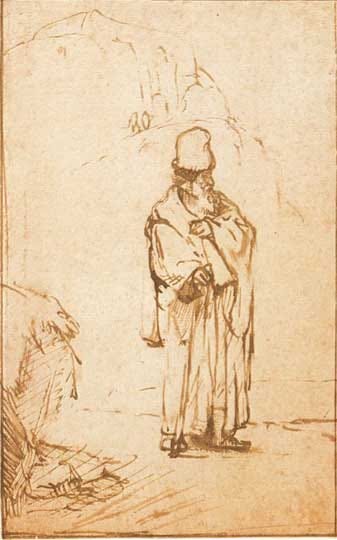
And then this—Elijah’s response. “When Elijah heard it…” One must keen to hear a soft whisper, but what must one do to hear a thin silence? It is hard to say, but Elijah’s movements are telling. In response to the sheer silence, he wraps his cloak around his face. A vivid action that multiples our questions. Does he wrap the cloak around his face in order to hear the voice within the folds? Does he seek to wrap up the thin whisper so as not to lose it? Is he veiling his face, as Moses did after descending the mountain of God? Perhaps he covers his eyes, so that he might better tune his ears to the sound of sheer silence.
This phrase, “sheer silence”, and these movements, the folding of the cloak around the face, seek to not to capture or crystalize the voice of the Lord, but to simply hint at the deep mystery of elusiveness. This, according to Walsh in his Berit Olam commentary on 1 Kings, is precisely the point. As he puts it, “The numinous power of the image lies precisely in our inability to grasp it—a quality utterly lost by translations that render it a “a thin, whispering sound” or the like; the NRSV’s “sound of sheer silence” captures the sense perfectly without losing any of its mysterious paradox.”
We might therefore take elusiveness as a provocation, a warning against the impulse to capture things, to understand them precisely. Indeed, I think it is a provocation, just as Jesus’ parables are a kind of provocation. Parabolic meaning, wherein one thing is thrown alongside another in order to draw out something new and often unexpected, contains within it a kind of judgement too. Jesus connects the judgement of parables to the calling of Isaiah. The prophet is told, and Jesus echoes, that there will be those with eyes that do not see and those with ears that do not hear.
The provocation that we see but do not see and hear but do not hear is also an invitation into deeper perception. What is the invitation? It is a summons to stalk the elusive, to quest after what is concealed, not to capture something, but instead to receive something. Indeed, in the words of Proverbs, “It is the glory of God to conceal things, but the glory of kings to search things out” (Proverbs 25:2). The kingly vocation of humanity, that which is a sense highest and best, most royal in our humanity, involves seeking, searching out, stalking the elusive prey. In The Republic Socrates describes the quest for wisdom as a hunt, saying to Glaucon of their pursuit for the meaning of justice: “So then, Glaucon, we must, like hunters, now station ourselves in a circle around the thicket and pay attention so that justice doesn’t slip through somewhere and disappear into obscurity. Clearly it’s somewhere hereabouts. Look to it and make every effort to catch sight of it; you might somehow see it before me and could tell me” (The Republic, translated by Allan Bloom, 432b)
There is a questing need for humans to grow in perception, but sometimes hunting looks like waiting, as we learn from Annie Dillard in Pilgrim at Tinker Creek in her desire to “stalk” muskrats:
“In summer, I stalk. The creatures I seek have several senses and free will; it becomes apparent that they do not wish to be seen. When I stalk this way I take my stand on a bridge and wait, emptied…It used to bother me…I just could not bear to lose so much dignity that I would completely alter my whole way of being for a muskrat. So I would move or look around or scratch my nose, and no muskrats would show, leaving me alone with my dignity for days on end, until I decided that it was worth my while to learn—from the muskrats themselves how to stalk.”
Esther Meek, in Loving to Know,reflecting on this passage from Dillard, notes what Dillard’s stalking of muskrats can teach us about “inviting the real.” There is a comportment, a disposition, marked by humility and a willingness to wait, that invites the elusive:
“Stalking muskrats can only be done by the ‘via negativa’—meaning that you must compose yourself to do nothing but wait, still enough, long enough, so that, if you are lucky, the muskrat will come. You must do it on the muskrat’s terms, not on your terms. If indeed you are lucky, even if you get only a wee glimpse, you sense the glory of the this condescension. Dillard likens it to Moses getting a wee glimpse of Yahweh, and Heisenberg uncovering the Uncertainty Principle. Note that it is not the knower who is in the driver’s seat, but rather the yet-to-be-discovered reality. The real discloses itself, in its own time and way. And when it does, it is grace.”
Dillard’s Pilgrim at Tinker Creek is a book long demonstration of how patient waiting and silent stillness can transfigure what is elusive into the effusive. This is the nature of contemplation as well, whether of a painting, a piece of literature, a symphony, the Word of God, or silence. Contemplation is first not a technique but a posture, a mode of being. Notice that Dillard said she had to be willing to change her mode of being to stalk the muskrats; she had to be willing to become undignified. To wait in silence has a kind of indignity to it. It is an implicit confession that we have nothing to offer but are willing to receive. If we would receive the elusive, if we would ‘invite the real,” then we must learn a new disposition and new posture and new way of receiving.
This disposition is what Augustine calls “learned ignorance”, and for me this has been one of the great lessons of art that taught something about God’s voice. Its elusiveness is often a provocation, but a provocation that is an invitation to wait, to pause, to listen. This was the Lord’s provocation to Elijah as well, as he sought to teach the prophet the full scope and qualities of his voice, the VOICE that thunders, but also the voice that whispers more silent than silence, but more inward than silence too.